


Amazon Winds Down Flagship Nova Models in AI Strategy Shift
Amazon is reportedly reducing development of several flagship artificial intelligence models as part of a broader effort to concentrate its …
Type a keyword and matching services will appear here instantly.
Click the heart icon on any AI service card to keep it here for later.
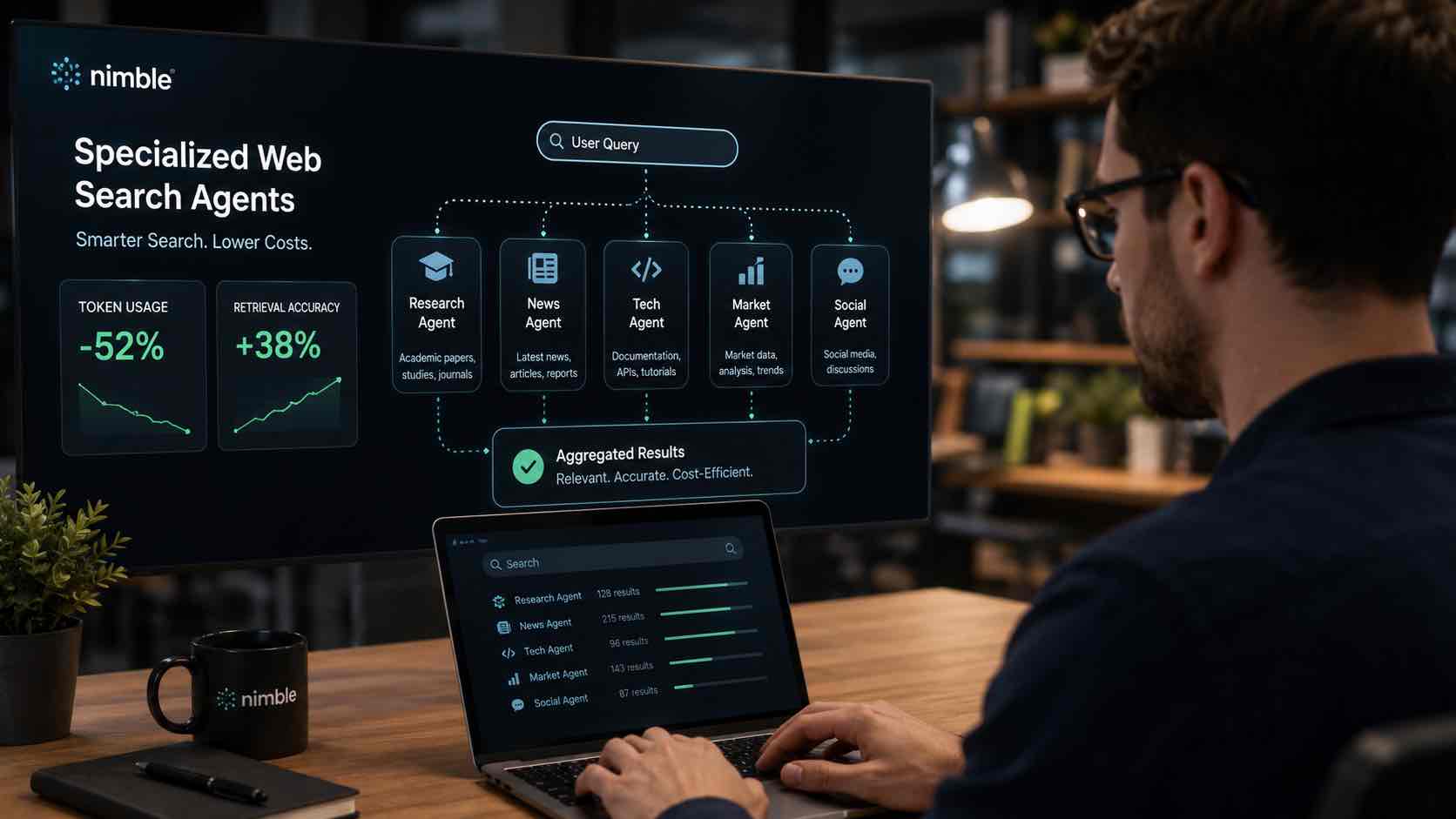
Nimble has launched a new platform that gives artificial intelligence agents domain-specialized access to live web information.
The company says Nimble Web Search Agents can improve retrieval accuracy while reducing the number of searches, tool calls and tokens required to complete complex research tasks.
Unlike general-purpose search tools, the system is designed to learn which sources, data formats and retrieval methods are most useful for each customer’s specific domain.
A specialized search layer
Generic web search systems usually apply similar retrieval logic across very different tasks.
A sales agent researching potential customers may receive results produced through the same process as an insurance agent checking claims or a retail agent monitoring product prices.
Nimble argues that this creates unnecessary noise. The calling AI model must spend additional tokens opening pages, filtering irrelevant information and deciding which sources can be trusted.
Web Search Agents instead adapts its search behaviour to the work an organization repeatedly performs. The system can learn which websites are useful, where relevant data usually appears and how deeply each source needs to be searched.
How the system works
Nimble describes the platform as a managed search harness.
A harness includes the tools, memory, execution rules, retries and safeguards surrounding an AI model. Nimble’s “Harness as a Tool” approach allows an existing agent to delegate a full research task to a specialized search system rather than manage each search step itself.
For every request, the platform creates an auditable search plan, searches Nimble’s independent index and uses live browsers to retrieve relevant pages.
It then coordinates extraction, memory, caching and evaluation before returning a cited result with confidence information.
The calling agent remains in control and can set limits on cost, sources, depth and search behaviour.
Search improves through use
The platform stores information about previous searches and the sources that produced useful evidence.
That memory helps future requests avoid unproductive websites and focus on retrieval paths that have already worked for similar tasks.
Nimble says the system can also be adapted using a company’s trusted sources, terminology, schemas and definition of a successful answer. The resulting retrieval knowledge can remain within the customer’s tenant.
This approach is intended for repeated business workflows such as market research, lead enrichment, compliance monitoring, pricing intelligence and competitor analysis.
Accuracy and token claims
Nimble reported that one customer recorded a 21% improvement in accuracy while reducing total AI token consumption by 51%.
The company’s broader expert-task evaluation showed exact-answer accuracy rising from 22% with baseline web search to 46% with generic deep research and 71% with its specialized harness.
Tokens used per resolved query fell from 38,000 to 11,200, while average web tool calls declined from 14 to four. Nimble also claims that selected workloads achieved cost savings of up to 20 times compared with other search systems.
These results were published by Nimble and may not represent every production environment. Performance will depend on the domain, source availability, query complexity and the agent connected to the platform.
Vertical benchmarks
Nimble says general research benchmarks do not accurately reflect many production tasks.
Its vertical evaluations use questions designed around specific categories such as go-to-market research, company analysis, market intelligence and social media monitoring.
The company reported scores of 88.8% for go-to-market research, 96.1% for company research, 84% for market analysis and 83.5% for social monitoring.
Nimble recommends that customers also create internal benchmarks using the real questions their agents are expected to answer.
This is important because a search system that performs well on broad knowledge questions may still struggle with specialized sources, terminology or structured data.
Customer use cases
AI-native CRM company Rox reported a 20-fold reduction in token costs after adopting the platform, alongside improvements in the completeness and quality of information delivered to its agents.
Code integrity company Qodo has also used the system to tune a Claude-based agent around specific competitor signals rather than generic market summaries.
These examples support Nimble’s argument that retrieval should be optimized around the final business task rather than treated as a standard search function.
Developer access
Web Search Agents is available through an API, software development kit and hosted Model Context Protocol server.
Developers can connect the platform to an existing agent or use it for deeper research, structured data generation and lower-latency search applications.
Nimble says its infrastructure processes more than 90 million searches per day for enterprise and AI-native customers.
The launch reflects a wider change in agent development. As AI models become more capable, the quality and cost of external information retrieval are becoming increasingly important.
Nimble’s strategy is to make web search itself adaptive, allowing agents to retrieve less irrelevant information while producing answers supported by more useful evidence.
Receive our latest updates about our products & promotions
Amazon is reportedly reducing development of several flagship artificial intelligence models as part of a broader effort to concentrate its …

Apple has reclaimed its position as the world’s most valuable public company after a sharp decline in Nvidia shares intensified …

Meta CEO Mark Zuckerberg predicts that billions of people could have personal artificial intelligence agents within the next five years. …