

Amazon Winds Down Flagship Nova Models in AI Strategy Shift
Amazon is reportedly reducing development of several flagship artificial intelligence models as part of a broader effort to concentrate its …
Type a keyword and matching services will appear here instantly.
Click the heart icon on any AI service card to keep it here for later.
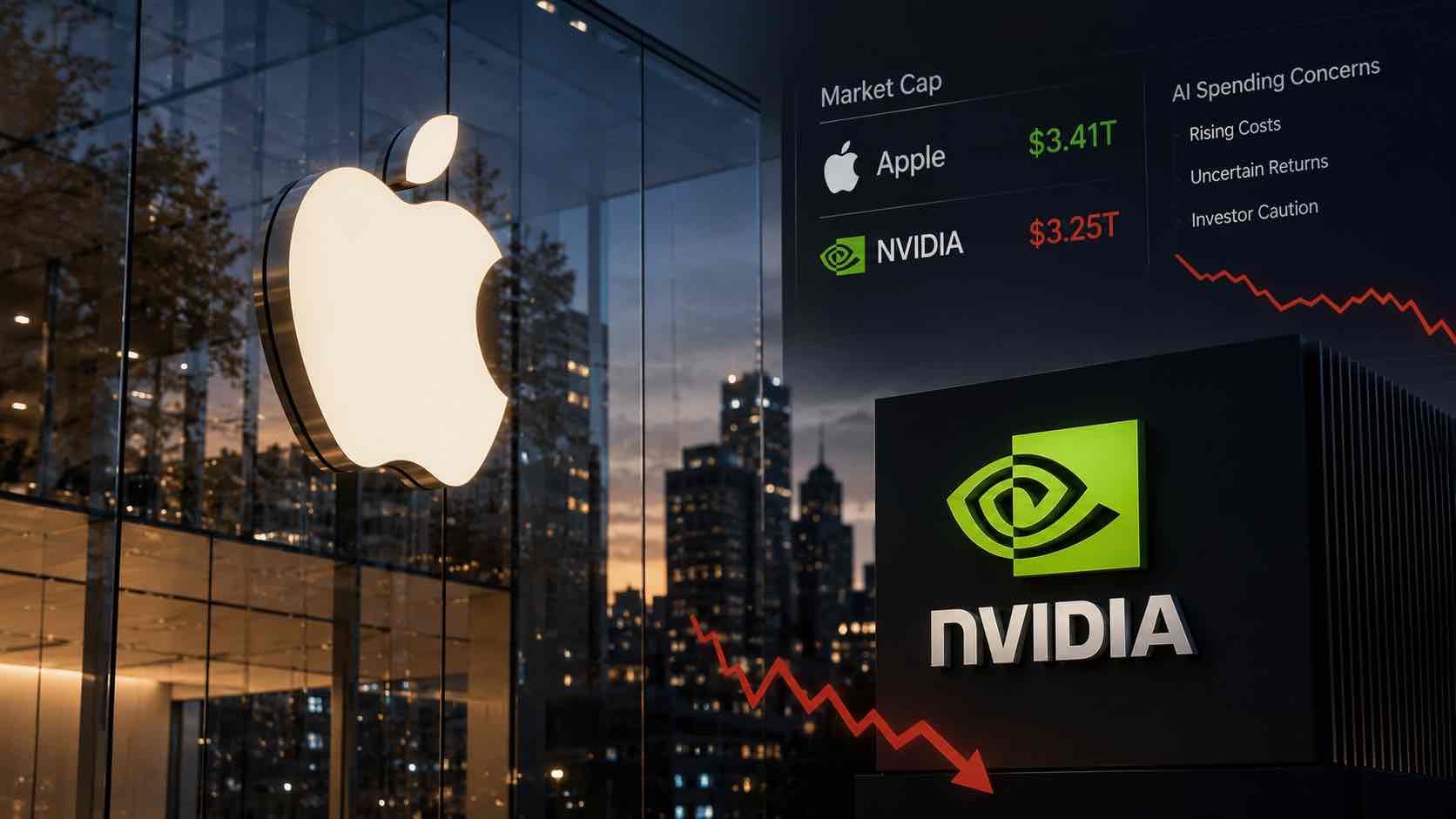
Apple has reclaimed its position as the world’s most valuable public company after a sharp decline in Nvidia shares intensified concerns about the financial risks surrounding the artificial intelligence infrastructure boom.
Nvidia stock fell approximately 5% on July 27, pushing the chipmaker’s market capitalization below Apple’s. Apple reached a valuation of about $4.93 trillion at the close, compared with roughly $4.78 trillion for Nvidia.
The shift represents a significant reversal. Nvidia had led the global market-capitalization ranking during much of the AI investment surge, while Apple faced criticism for moving more slowly in generative AI.
Nvidia financing worries
The Nvidia selloff followed reports that the company could provide a financial backstop of approximately $250 billion for a large OpenAI data-center project.
Investors are concerned that Nvidia may be taking on greater financial exposure to companies that already purchase large quantities of its chips. Critics describe such arrangements as circular financing because a chip supplier may invest in or guarantee financing for customers that then use the money to buy its hardware.
The potential OpenAI project could also involve hundreds of billions of dollars in future chip purchases. While that would support Nvidia’s revenue, it raises questions about who ultimately carries the financial risk if AI companies fail to generate enough income from their infrastructure.
Nvidia has been one of the largest beneficiaries of global AI spending, making its valuation particularly sensitive to any sign that data-center investment could slow.
AI spending faces scrutiny
Investors are becoming more cautious about the enormous sums technology companies are committing to AI infrastructure.
Alphabet recently reported negative quarterly free cash flow after increasing spending on data centers and chips. Meta, Amazon and Microsoft are also investing heavily in computing capacity, while OpenAI’s long-term cloud commitments have continued to expand.
The concern is not that demand for AI will disappear. Instead, investors want clearer evidence that revenue from AI products can grow quickly enough to justify the cost of processors, electricity, networking and data-center construction.
Nvidia depends on continued spending from the same cloud providers and AI laboratories now facing pressure to demonstrate returns. Any reduction in their investment plans could affect demand across the wider semiconductor supply chain.
Apple benefits from restraint
Apple has followed a different strategy.
The company has avoided building AI infrastructure on the same scale as Alphabet, Meta, Microsoft and Amazon. It has relied more heavily on partnerships and integration with its existing devices and services.
This restrained approach has helped Apple protect its free cash flow and avoid the large debt and infrastructure commitments affecting some of its competitors. Investors are currently rewarding that financial discipline.
Apple shares have also benefited from strong product demand and expectations for revenue growth. The stock has gained around 25% in 2026, outperforming Nvidia and several other major technology companies.
On July 28, Apple briefly exceeded a $5 trillion market capitalization for the first time. It became only the second company to reach that level after Nvidia.
Chip competition increases
Nvidia is also facing growing competition.
AMD is expanding its Instinct accelerator and Helios rack-scale systems, while major cloud providers are developing their own AI processors. Chinese companies are releasing more efficient models and investing in domestic semiconductor production.
The public listing of Chinese memory-chip company CXMT added to concerns that China could become a stronger competitor in advanced chips and supporting technologies. Asian semiconductor shares also fell as investors reassessed the sustainability of AI infrastructure spending.
Nvidia continues to dominate the AI accelerator market and remains highly profitable. However, its position as the central supplier of the AI boom means its stock can experience sharp declines whenever confidence in industry spending weakens.
A shift in investor priorities
Apple’s return to the top of the market-capitalization ranking reflects a broader change in investor sentiment.
During the first stage of the AI boom, markets rewarded companies making the largest investments in models, chips and data centers. Investors are now placing greater emphasis on cash flow, financial risk and the ability to generate sustainable returns.
Apple is benefiting because it combines a large and profitable consumer ecosystem with comparatively limited AI infrastructure spending.
Nvidia remains one of the most important companies in artificial intelligence, but its recent decline shows that investors are no longer treating every major AI investment as automatically positive.
The next stage of the AI market may be defined less by how much companies spend and more by how effectively they convert that spending into revenue and profit.
Receive our latest updates about our products & promotions
Amazon is reportedly reducing development of several flagship artificial intelligence models as part of a broader effort to concentrate its …

Nimble has launched a new platform that gives artificial intelligence agents domain-specialized access to live web information. The company says …

Meta CEO Mark Zuckerberg predicts that billions of people could have personal artificial intelligence agents within the next five years. …