


AI Giants Head to White House for Safety Talks
The White House has invited OpenAI, Anthropic, Meta and Google to discuss a new voluntary framework for testing the cybersecurity …
Type a keyword and matching services will appear here instantly.
Click the heart icon on any AI service card to keep it here for later.
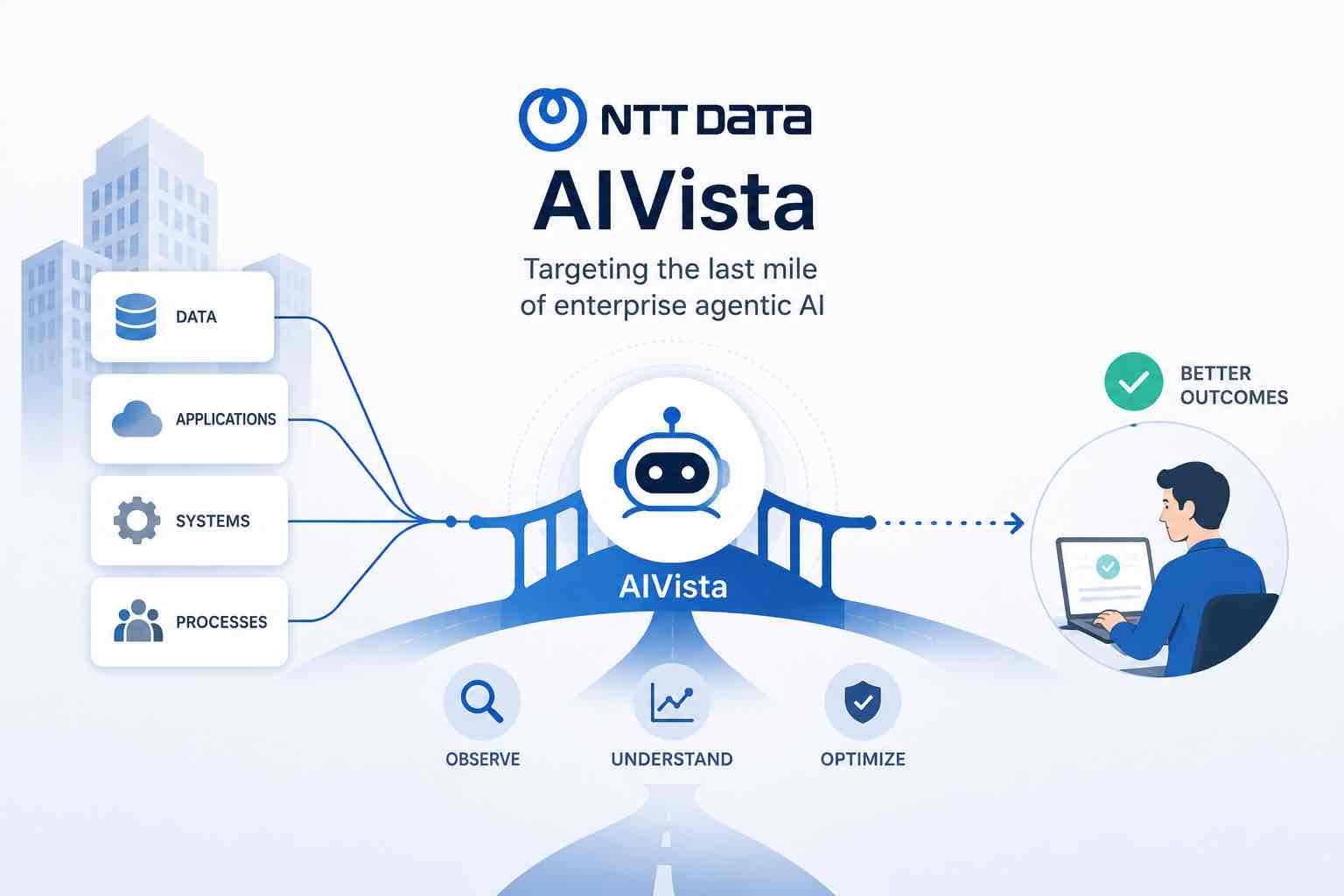
Enterprise AI models are becoming more capable, but many organizations still struggle to turn them into reliable systems that can perform real business work.
NTT DATA AIVista is attempting to close this gap by combining foundation models with proprietary business knowledge, workflow integration, governance and production infrastructure. The company describes this work as the “last mile” of enterprise AI—the distance between a capable general-purpose model and an agent that can safely operate inside a specific organization.
Why enterprise AI projects stall
Connecting a model to an API is relatively simple. Turning it into an agent that understands an organization’s policies, terminology, exceptions and approval processes is significantly more difficult.
Foundation models are trained largely on public information. They may understand general banking, insurance or manufacturing concepts, but they do not automatically know a company’s internal risk rules, customer classifications, regulatory interpretations or operating procedures.
NTT DATA AIVista identifies four common barriers preventing companies from moving AI projects into production: weak data foundations, insufficient domain specialization, inadequate governance and poor organizational change management.
Enterprise data is often fragmented across databases, applications and document systems. Even when that information is accessible, inconsistencies and missing context can prevent an agent from making reliable decisions.
The organization must also prepare employees, redesign processes and define responsibility for decisions made or supported by agents. Without those changes, a technically successful pilot may still fail to produce measurable business value.
Specializing agents for each organization
AIVista’s central idea is that enterprise agents must be adapted to the environment in which they will operate.
Its platform uses company and industry data to create specialized models and agents for individual workflows. This may include internal terminology, business rules, policies, historical decisions and permitted actions.
The system also includes an AI-native knowledge base designed around NTT DATA’s understanding of customer data and operational processes. Rather than treating enterprise information as a collection of documents, the platform connects that knowledge directly to domain-specific agent workflows.
This specialization is particularly important in regulated industries, where a small mistake can result in financial losses, compliance problems or incorrect customer decisions.
Governance during execution
Enterprise governance cannot rely only on reviewing an agent after it has completed a task.
Organizations need controls that determine which information an agent can access, which tools it can use, how much it can spend and when human approval is required. They also need records explaining which model, data and policy checks influenced each action.
AIVista says its platform embeds governance into agent decisions. It combines the reasoning capabilities of language models with symbolic verification intended to produce auditable decisions rather than relying only on probabilistic confidence scores.
The platform’s execution layer includes orchestration, memory, observability and runtime governance. These components are designed to help companies track agent behavior, investigate errors and enforce policies while workflows are running.
Runtime controls are also important for managing costs. Agentic systems can make multiple model calls, use external tools and repeat tasks, causing expenses to change during execution. AIVista argues that companies need enforceable budgets and workflow-level cost attribution rather than discovering overruns after a project has finished.
A model-independent approach
AIVista does not require customers to use a single foundation-model provider.
The platform is designed to route each task to an appropriate model based on performance and cost. A simple classification task could be handled by a smaller model, while a complicated analysis could be sent to a more capable system.
This model-independent approach may help organizations control spending and avoid becoming entirely dependent on one AI vendor. It also allows customers to adopt newer models without rebuilding the complete workflow around them.
However, model selection is only one part of the system. The data layer, business context, guardrails and workflow integrations must remain consistent when the underlying model changes.
Service-as-Software
NTT DATA AIVista describes its strategy as Service-as-Software.
Traditional enterprise software provides tools that employees configure and operate. A Service-as-Software system is intended to perform more of the work itself and deliver a completed business outcome through AI agents.
AIVista combines its platform with NTT DATA’s consulting, engineering and industry experience. The goal is to take responsibility for the complete workflow rather than selling an isolated AI model or development tool.
The company is focusing on mission-critical operations, particularly in regulated sectors such as banking and insurance. These environments require reliability, auditability and clear ownership of results before agents can be trusted with production tasks.
Part of NTT DATA’s wider AI strategy
NTT DATA established AIVista in Silicon Valley in December 2025 as a wholly owned company. It appointed former AWS, Nvidia and DigitalOcean executive Bratin Saha as CEO.
The business is intended to combine Silicon Valley AI expertise with NTT DATA’s existing enterprise relationships, systems-integration capabilities and industry knowledge.
NTT DATA is also developing a core AI platform containing the common functions required to integrate agents into business processes. These include company policies, industry rules, operational decisions and workflow execution. The group planned to begin using the platform in selected projects during the second quarter of its 2026 fiscal year.
Moving agents beyond demonstrations
The next stage of enterprise AI will depend less on whether a model can complete an impressive demonstration and more on whether the complete system can operate safely at scale.
Companies need agents that understand proprietary context, connect with existing applications, follow enforceable policies and provide evidence for every important decision.
NTT DATA AIVista is positioning itself as the layer that connects advanced models with these operational requirements.
Its success will depend on whether the platform can produce measurable improvements in cost, speed and accuracy while meeting the security and compliance standards demanded by large enterprises. But its focus reflects an important shift in the AI market: the foundation model may provide the intelligence, while the systems built around it determine whether that intelligence creates real business value.
Receive our latest updates about our products & promotions
The White House has invited OpenAI, Anthropic, Meta and Google to discuss a new voluntary framework for testing the cybersecurity …
Apple’s long-awaited Siri upgrade has arrived in the consumer beta version of iOS 27, delivering many of the capabilities the …

Meta says artificial intelligence is dramatically reducing the time required to develop and launch consumer applications, allowing the company to …